
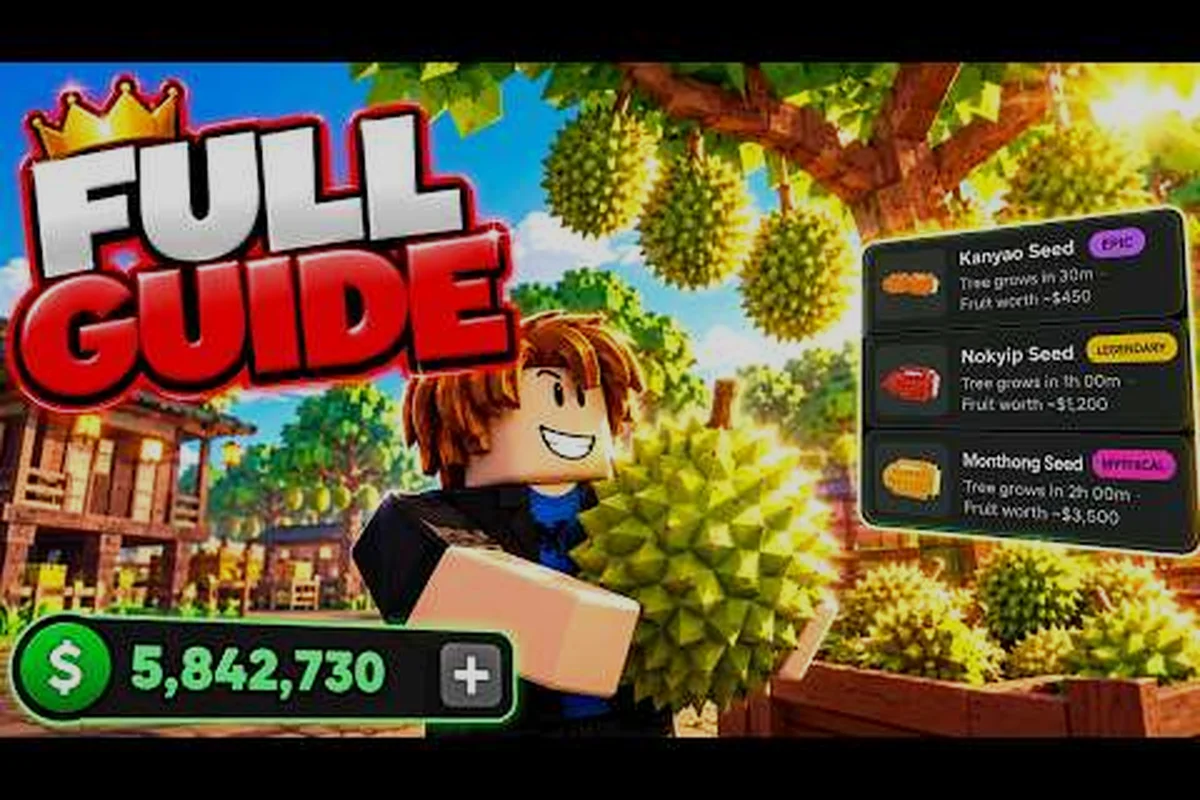
The durian garden wiki is a structured reference for this Roblox farming tycoon from Mini Richy In Game Groups. It gathers the information players most often look up in one place: the planting, boosting, harvesting, truck-loading, and selling production loop that drives every farm; the launch facts and official server details you can verify on the game page; the small-server multiplayer behavior that shapes each session; and the progression logic behind land, upgrades, and plot expansion.
Durian Garden Wiki Overview and Game Facts
The durian garden wiki is a practical reference for understanding this Roblox farming tycoon’s core loop, launch details, and progression systems. It matters because the game combines planting, growth acceleration, harvesting, truck loading, and selling into one repeatable economy, while its multiplayer structure changes how efficiently players can expand. Get the verified facts below, then use the farming and upgrade advice to build a stronger foundation.
According to the official Durian Garden game page, the game is classified as a Simulation / Tycoon experience created by Mini Richy In Game Groups. Its listed launch date is October 21, 2026, and the build name carries an UPD] prefix, indicating that the experience was undergoing active iteration when the page was checked. That distinction matters for a durian garden wiki because menus, prices, and interface details may change as the developer continues updating the game.
The central activity is straightforward: players grow durian trees, use available boosts to move them toward maturity, harvest the fruit, load the harvest into a truck, and sell it for cash. Cash then feeds back into the farm through new land, better equipment, larger plots, and other upgrades. This creates a consistent progression loop in which every harvest can support a larger production cycle.
| Verified detail | Information |
|---|---|
| Platform | Roblox |
| Genre | Simulation / Tycoon |
| Developer | Mini Richy In Game Groups |
| Listed launch date | October 21, 2026 |
| Official server capacity | 8 players |
| Core production loop | Plant, boost growth, harvest, load, sell |
| Main reinvestment targets | Land, upgrades, and bigger plots |
The official page’s platform snapshot, recorded on November 1, 2026, also listed approximately 9.44 million visits, 31,127 concurrent players, and 9,721 favorites. Those figures describe that specific snapshot rather than permanent performance, but they establish Durian Garden as a popular Roblox release with a sizable audience. For broader background, the complete game overview provides additional context on the experience beyond this systems reference.
Durian Garden Launch Facts and Core Systems
Durian Garden is built around a five-stage production cycle, and understanding each stage prevents players from overlooking a source of income. Planting establishes the crop, boosting reduces the waiting period, harvesting converts mature trees into produce, loading organizes the yield for delivery, and selling turns the load into cash. Each stage feeds directly into the next, so improving only one part of the cycle can create a bottleneck elsewhere.
| Production stage | Player action | Economic result | Common mistake |
|---|---|---|---|
| Planting | Add a durian tree to available space | Begins a potential harvest | Filling plots without checking upgrade value |
| Growth boosting | Apply available boosts | Shortens time before harvest | Spending boosts before higher-value production is ready |
| Harvesting | Collect mature fruit | Creates sellable inventory | Leaving mature trees unattended |
| Truck loading | Transfer fruit into the truck | Prepares a delivery payload | Selling before the payload is worth more |
| Selling | Complete the sale | Produces cash for reinvestment | Ignoring land and equipment costs |
The practical lesson is that the fastest player is not always the one who taps the most quickly. A player who upgrades the truck, gains useful land, or improves production can create more value from the same harvesting action. This is why the game is more than a simple clicker: time efficiency, cash flow, and reinvestment priority determine whether a farm stays competitive.
The cycle also gives the game a clear sense of progression. Early players generally focus on completing the basic route from planting to a sale, while later progress comes from expanding capacity and making each visit more productive. The beginner guide walks through the first steps, but the key long-term rule is simple: buy an upgrade only when it increases future harvests, frees attention, or reduces a repeated bottleneck.
Durian Garden Story, Setting, and Progression
The durian garden story is intentionally focused on building a productive fruit operation rather than following a character-driven adventure. The game’s subject matter comes through its actions: cultivating a distinctive crop, managing a truck-based delivery business, and turning farm income into a larger enterprise. That design choice makes progression visible through physical changes to the plot and equipment instead of through a long linear narrative.
The setting follows the logic of a stylized Roblox tycoon. A player begins with limited land and basic production, then earns cash by selling harvested durian. Reinvestment allows the farm to expand, and expansion creates a reason to repeat the original cycle more efficiently. The plot therefore acts as a visual record of progress: more trees indicate greater production capacity, while improved transport suggests a business capable of moving larger loads.
| Progression layer | What changes | Why it matters |
|---|---|---|
| Farm capacity | Additional land and trees | Supports more simultaneous production |
| Growth speed | Faster maturation or better boost value | Reduces idle time per cycle |
| Harvest value | More produce or stronger output | Raises revenue from each completed cycle |
| Truck system | Better carrying and selling capacity | Prevents transport from limiting income |
| Reinvestment | Land, upgrades, and larger plots | Improves future earnings rather than current cash |
This is where the durian garden story differs from a quest-heavy narrative game. Progression is measured through cash flow, plot size, and production efficiency, so the player’s primary objective is to turn a small harvest operation into a more productive enterprise. A player who understands that progression loop can prioritize meaningful purchases rather than simply spending money on every visible upgrade.
The active UPD] prefix on the listed build also matters when researching the game. It suggests continued development, so exact prices and interface labels should be confirmed in-game. For a time-sensitive overview of recent additions and current player priorities, the 2026 game guide offers a useful companion to this durian garden wiki.
Durian Garden Multiplayer and Server Details
Durian Garden multiplayer centers on shared Roblox servers with a listed limit of 8 players. That capacity places the game in the small-server range, which can make each visit feel more noticeable than it would in a mass-player environment. Players can still follow their own farming routine, but the limited server size creates more opportunities for accidental interference, especially around shared production spaces or busy selling points.
| Multiplayer detail | Verified information | Practical implication |
|---|---|---|
| Server type | Standard Roblox server | Sessions may change as players join or leave |
| Listed maximum | 8 players per server | Smaller population than many Roblox simulators |
| Main interaction layer | Shared physical spaces | Players may gather around key objectives |
| Competitive option | Game modes described separately | Group play and team details deserve separate review |
| Platform visibility | Public Roblox listing | New updates can attract larger temporary crowds |
The most important multiplayer consideration is server awareness. Before planting, boosting, loading, or selling, check which plots and equipment are available and whether another player is already using them. Since the server cap is relatively low, there is less anonymity than in games designed for dozens or hundreds of simultaneous participants, and a brief pause can prevent wasted inputs or awkward collisions.
Community experience also suggests that player behavior can vary by session. Some groups cooperate around the same goal, while others focus on independent tycoon progress. For broader coverage of those arrangements, the game modes overview explains how group play differs from the standard farming routine. The key takeaway is that multiplayer does not replace the need for good timing; it adds another layer of awareness because visible players may be pursuing the same upgrades and activities.
Durian Garden Systems, Upgrades, and Economic Strategy
A strong economic strategy starts with identifying the slowest profitable action in the current loop. If trees mature quickly but the truck takes too long to load, additional trees will not produce more income. If the truck is ready but available land is limited, buying land may create the strongest return. This simple diagnosis prevents players from buying upgrades that look attractive without addressing the current constraint.
| Current bottleneck | Better investment direction | Reason |
|---|---|---|
| Trees remain immature | Growth boost or faster growth upgrade | Reduces waiting time before harvest |
| Produce accumulates | Truck capacity or loading improvement | Converts stored fruit into saleable value |
| Land fills quickly | Land expansion or plot upgrade | Creates room for more production |
| Harvests sell for too little | Value or selling-related upgrade | Raises revenue without requiring more manual cycles |
| Several minor delays | Balanced farm efficiency | Improves the loop without specializing too narrowly |
Prioritization should also consider return time. A fast-payback upgrade is one that adds enough cash or saved time to repay its price before the player loses interest. By contrast, an expensive upgrade with an unclear benefit may look grand but delay the next meaningful purchase. Players should watch their cash balance, record the current bottleneck, and compare each purchase with the part of the loop it improves.
There is another practical distinction between growth boosts and permanent expansion. A boost helps accelerate the current cycle, while land, truck improvements, and similar upgrades can affect many future cycles. The best mix usually combines temporary acceleration with long-term capacity. Spending every available resource on immediate boosts may feel productive, yet it can leave the underlying farm too small to convert that extra time into meaningful income.
The broader optimization lessons in the game information guide can help with specific upgrade decisions, but this durian garden wiki frames them around one test: does the purchase improve output, reduce waiting, or increase sale value? If it does not answer at least one of those questions, it deserves another look before the money is spent.
Early-Game Priorities for New Growers
New growers should first secure a complete sale before worrying about advanced optimization. That means planting a tree, using an available boost, harvesting the mature fruit, loading the truck, and converting the payload into cash. Completing this sequence establishes the baseline economy and reveals where delays occur. A farm that has not completed a full cycle cannot be evaluated fairly, because missing revenue from one stage changes the value of every later upgrade.
| Priority | Action | Reason |
|---|---|---|
| 1 | Complete one full production cycle | Establishes how every system connects |
| 2 | Harvest mature trees promptly | Prevents produce from becoming the next bottleneck |
| 3 | Load before selling | Ensures the truck contributes its full value |
| 4 | Buy the first bottleneck upgrade | Produces a larger return than scattered spending |
| 5 | Expand capacity after stabilizing | Supports repeat visits with more output |
| 6 | Recheck multiplayer conditions | Avoids conflicts in a small server |
A common early mistake is treating every available screen button as equally urgent. Because growth boosting and harvesting occur on a time scale, players should decide which tasks can be handled together during one visit. If a tree needs a short boost while another is ready to harvest, handling those together reduces idle time. However, this should not become a rule that makes every action automatic; checking the server and available plot space still matters.
The early phase is also when cash discipline matters most. It is tempting to spend immediately because the upgrade icon creates a clear sense of progress, but a short pause can reveal whether the purchase solves a real problem. New players should favor a repeatable income loop, then reinvest in the part of that loop that currently limits production. This approach supports steady growth without requiring advanced game knowledge.
Maintaining Progress in an Updated Roblox Game
Because the listed build includes an UPD] prefix, Durian Garden may change as the developer adds features or adjusts balance. This does not make the core loop uncertain; planting, growth, harvesting, loading, and selling remain the clearest path to understanding the game. It does mean that prices, labels, event details, and interface positions should be treated as version-sensitive unless the official page confirms them.
| Information type | Reliability approach |
|---|---|
| Core farming actions | Use the official page and direct in-game observation |
| Launch date and developer | Use the official Roblox listing |
| Server capacity and platform snapshot | Use the listing data recorded November 1, 2026 |
| Prices and upgrade costs | Confirm in the current build |
| Player strategies | Treat community reports as helpful but potentially outdated |
| Event or update details | Check the official game page for current announcements |
A durable wiki habit is to record both the source and date of a claim. Platform visits and active-player counts naturally change, and a community strategy may stop being optimal after an update. The most reliable durian garden wiki distinguishes permanent mechanics from temporary platform figures, which helps readers know when a number needs confirmation.
Players should also check whether recent changes affect cooperation, inventory, or movement before joining a busy session. The multiplayer and player capacity reference provides additional context on joining and server behavior. Even with changing builds, the best long-term method remains simple: observe the current loop, identify its delay, test an improvement, and keep the change only if the result is visibly better.
Frequently Asked Questions
What is Durian Garden?
Durian Garden is a Roblox farming tycoon by Mini Richy In Game Groups. Players plant durian trees, accelerate their growth, harvest the fruit, load it into a truck, and sell it for cash. The official Roblox listing identifies it as a Simulation / Tycoon game and gives October 21, 2026 as its launch date.
Is Durian Garden multiplayer?
Durian Garden multiplayer runs through public Roblox servers, and the official listing reports a maximum of eight players per server. Because the population limit is relatively small, players share the same physical spaces more closely than they would in a large simulator. Check plot availability and nearby player activity before beginning a production step.
Does Durian Garden have a story?
The game’s durian garden story centers on growing and selling durian rather than a character-led campaign. Players begin with a limited plot, complete the farming cycle, and reinvest earnings in land, equipment, and larger production. Progress is therefore communicated through an expanding tycoon operation, with new visual and mechanical improvements replacing a conventional linear plot.
When did Durian Garden launch?
According to the official Roblox game page, Durian Garden launched on October 21, 2026. The listing also displayed an update-related build prefix when checked, which suggests continued iteration. Because the game appears to be changing, players should verify event details and exact interface features inside the current build rather than relying on older screenshots.
What is the fastest way to earn more in Durian Garden?
The fastest route is to remove whichever stage limits the production cycle: growth time, available land, truck capacity, or sale value. Complete one full harvest and sale, then buy the upgrade that addresses the clearest delay. This targeted approach usually produces a better return than spending resources evenly across every available option.