
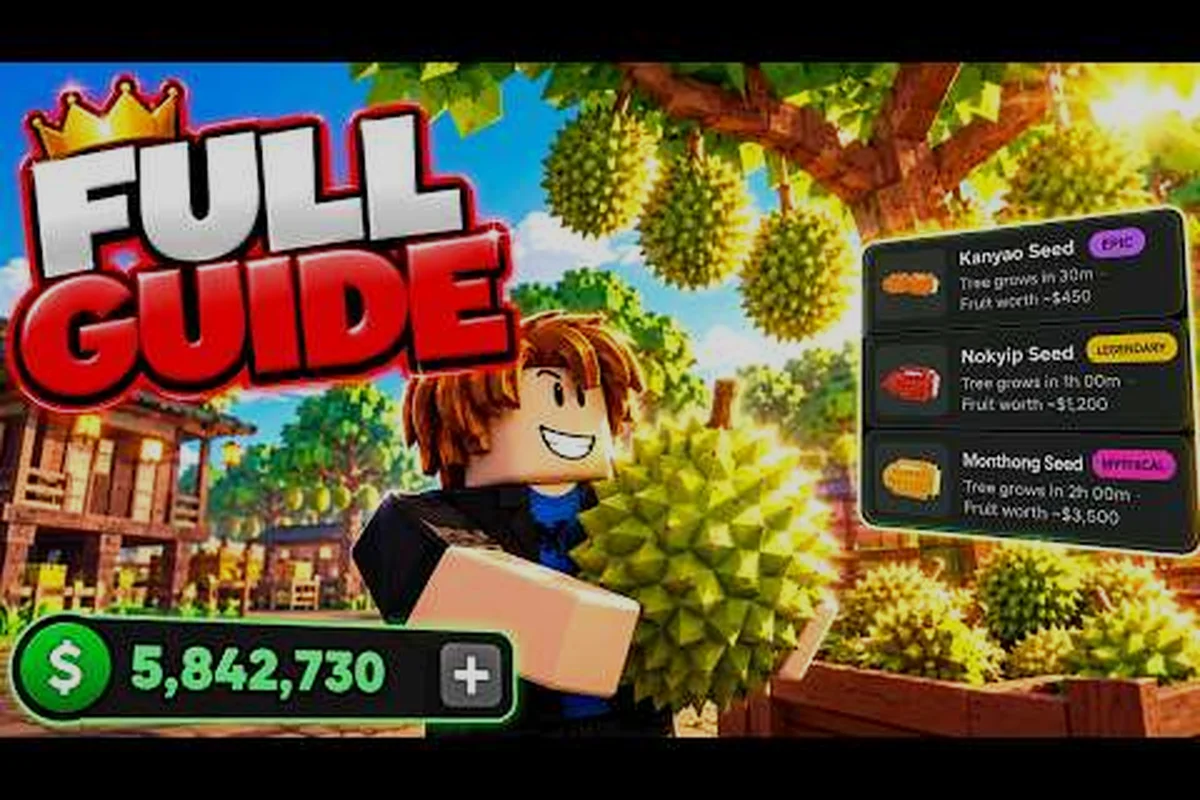
New players following this Durian Garden beginner guide should treat their first session as a production chain rather than a series of disconnected taps: plant durian trees, use growth boosts to shorten waiting time, harvest each ripe fruit, load the truck, and sell the cargo to earn cash. Starting with one planting cycle shows why early harvesting matters: every completed sale funds the next boost, while spending cash too soon can leave the farm unable to expand efficiently.
Durian Garden Beginner Guide: Understanding the First Session
Durian Garden is a Roblox farming tycoon by Mini Richy In Game Groups, and its core loop is straightforward: plant durian trees, accelerate their growth, collect the fruit, deliver it by truck, and reinvest the proceeds. The official game information describes it as a Simulation and Tycoon release launched on October 21, 2026, while the rapid update cycle may change individual menus or reward details.
That last point matters. Although the same basic cycle repeats, exact prices and interface arrangements can shift as the developer continues refining the game. Treat the verified figures in this Durian Garden beginner guide as a reliable starting method rather than a permanent balance patch.
| First-session objective | What to do | Why it helps |
|---|---|---|
| Establish production | Plant several trees across available soil | Creates future harvests while you work elsewhere |
| Shorten waiting time | Use the available growth-boosting option | Brings the first sale forward |
| Fill the truck | Collect mature fruit and load every available slot | Improves the value of one delivery |
| Restart the economy | Sell the load and purchase a useful upgrade | Converts temporary income into permanent progress |
The Core Farming Cycle
The first action is to plant a tree. Your starting plot provides the space needed for the entire early loop, so plant several trees instead of leaving valuable ground empty. While those trees grow, you can learn the interface, inspect available upgrades, and prepare for collection rather than simply standing beside an immature crop.
When a tree becomes harvestable, collect its fruit and place the durians into the truck. The truck is the bridge between farm production and cash. Once enough fruit is aboard, complete the delivery, sell the load, and decide whether the proceeds should buy more trees, improve growth speed, expand the plot, or increase carrying capacity.
This loop is the foundation of the durian garden roblox guide because every early decision affects how quickly it repeats. More planted trees can produce more fruit, but extra fruit has little value if your truck is already full or growth boosts are unaffordable.
Controls and Interface Priorities
New players often spend too long searching every icon while their first tree grows. Focus instead on the controls associated with planting, harvesting, loading, selling, and boosting. The interface may be reorganized during updates, so the labels can change even though the underlying activity remains recognizable.
Use these priorities to establish quick-to-read icon recognition: compare each control’s shape, color, and nearby label with its action—planting, harvesting, loading, selling, or boosting—rather than memorizing a fixed position. For example, a prompt near an empty soil patch is likely the planting control, while a pickup marker beside a mature tree indicates harvesting. If an update changes the layout, tracking these visual cues helps you identify the underlying activity faster and reduces pauses during the planting-to-selling cycle.
-
Find the planting prompt and place trees on open soil.
-
Locate the growth control and use it only when the cost fits your budget.
-
Identify the harvest prompt near mature trees.
-
Check truck capacity before beginning a collection run.
-
Locate the sale point and confirm the displayed total before confirming delivery.
Community game footage and player reports describe the same planting, growth-boosting, harvesting, truck-loading, and selling cycle. This NoobBlox first-session guide video can serve as a visual companion, especially if you prefer following the interface step by step rather than reading a text-only explanation.
Durian Garden How to Play: Planting, Growth, and Selling
A strong opening depends on timing rather than random spending. Plant enough trees to create a steady supply, but keep enough cash to accelerate at least one crop. If you spend everything on planting, you may have a full field and no way to shorten the wait before your first meaningful sale.
Planting the Right Number of Trees
New players commonly make one of two errors: planting a single tree and waiting, or immediately consuming every coin on a large field. The better balance is to cover the usable soil while preserving a growth reserve. Because the game launched recently and receives frequent updates, the exact starting costs may vary, but the economic logic remains stable.
A practical way to judge your planting density is to count expected harvests against available selling capacity: each mature durian tree adds another fruit to the truck load, while a full plot increases production faster than it increases income. For example, if your current truck can carry only a limited number of fruits, adding several trees may create a harvest queue before you have earned enough for a truck upgrade. Plant until the plot is mostly productive, but keep enough coins for essential boosts.
| Approach | Immediate benefit | Early drawback | Better when |
|---|---|---|---|
| One or two trees | Cheap start | Long gaps between harvests | Learning the controls |
| Fill most open soil | More frequent future harvests | Little cash left for boosts | The truck can carry the output |
| Fill all available soil | Maximum production potential | Upgrades may be delayed | You already know the sell cycle |
The best beginner setup is usually a nearly full plot with a small cash buffer. Revisit that choice whenever a truck upgrade increases your limit, because the amount of fruit you can actually sell becomes more important than the number planted.
Using Growth Boosts Efficiently
Growth boosts are most valuable when they shorten the gap between a harvest and your next full truck. Applying one to a nearly finished tree gives a quick return. Using several on young trees may produce a faster total cycle, but it can leave you without cash for necessities.
A practical sequence is to boost one tree, finish the collection and sale, then reinvest the profit into another boost or capacity improvement. This approach avoids wasting the boost on fruit that will sit in a full truck. If the game offers different boost durations or costs, compare the effective wait saved with the income lost before choosing.
| Boosting approach | Benefit | Risk | Recommended use |
|---|---|---|---|
| Immediate use on a mature tree | Fast harvest | Higher upfront cost | When truck space is the bottleneck |
| Use on a young tree | Earlier bulk harvest | Cash may run low | When the plot is nearly full |
| Save boosts | Preserves options | Longer wait | When several sales are already ready |
| Split across several trees | Balanced timing | More clicks to manage | After the first successful sale |
Harvest Only What the Truck Can Hold
Harvest only what the truck can hold, unless the game clearly allows overflow. A full truck means a complete sale, while extra fruit on the ground may not contribute until another delivery is possible. Before collecting, check the capacity indicator so you can plan whether to sell immediately or leave several trees ready for the next load.
The sales-volume principle is simple: more cargo per trip usually creates a stronger economy than repeatedly making short trips with partial loads. If upgrades offer a meaningful capacity increase, compare that benefit with growth speed. More capacity only pays off when the plot can produce enough fruit, while faster growth only pays off when the truck can accept the larger harvest.
When the load is ready, drive or trigger the delivery according to the current controls, then confirm the sale. Record the payout informally for a few cycles. You are looking for the pattern between planted trees, boosted growth, truck capacity, and final income—not an exact universal price.
Durian Garden Roblox Guide: Upgrades and Cash Decisions
Your first sale creates a reinvestment decision. Spending immediately is not automatically wrong, but the best purchase should address your current bottleneck. If the truck fills too quickly, improve capacity; if trees mature too slowly, improve growth; if empty soil limits production, expand the plot.
The official game page and community descriptions agree on a progression model in which profits are recycled into land, upgrades, and bigger plots. That model means a larger farm is only useful when the rest of the production chain can keep up. Buying land before handling growth and capacity can create more fruit than you can profitably convert into cash.
Matching the Upgrade to the Bottleneck
| Symptom | Likely bottleneck | Upgrade to consider first | Result to watch |
|---|---|---|---|
| Trees wait too long | Growth speed | Growth boost or faster maturity | Shorter time to harvest |
| Truck fills quickly | Carrying capacity | Larger truck | More fruit per sale |
| Sale value feels too small | Sale throughput | Capacity or production improvement | Higher income per cycle |
| Empty soil limits harvests | Plot size | Land expansion | More trees and future output |
| Cash disappears without progress | Spending order | Cost comparison before buying | Better early efficiency |
Do not buy several different upgrades in one transaction until you know which one changes the part of the loop that slowed you down. Early mistakes are costly because every upgrade competes with the others for the same limited cash. A single-change test—buy one, run a few cycles, compare results—creates useful evidence without requiring advanced knowledge.
A Practical Reinvestment Plan
Use the revenue from the first complete sale as a test budget. If the load was full and the sale felt worthwhile, preserve part of the money before making another purchase. If money fell short after planting, the next priority is not a bigger farm; it is completing the next sale more efficiently.
A simple three-stage plan works well because it ties each reinvestment decision to a measurable delivery milestone: cover planting and upkeep until a full truckload is ready, then use a portion of its sale revenue to shorten the wait for the next harvest. For example, reserving cash after one complete sale lets you buy only the growth or production upgrade that addresses the next bottleneck, while keeping enough funds to avoid another shortfall before the following delivery.
-
Production stage: establish several trees and secure one complete truckload.
-
Acceleration stage: spend on growth so the second load arrives sooner.
-
Scale stage: expand capacity or land after repeated deliveries show which resource remains limiting.
This plan reflects the durian garden game guide principle that upgrades should follow the loop rather than precede it. It also prevents the common beginner mistake of buying every available object simply because it appears on the menu. Durian Garden is a small farming economy, and wasted early cash can delay the next harvest more effectively than a slightly suboptimal upgrade choice.
Reading the Numbers Without Overanalyzing
Prices and costs can change with updates, so do not build the session around one remembered number. Instead, calculate the simple relationship between a sale and your next purchase. If a growth purchase costs much less than a sale, it may be affordable several times; if land costs multiple sales, saving for it becomes a medium-term goal.
| Metric | What to compare | Why it matters |
|---|---|---|
| Sale payout | Cash received after one full delivery | Measures current throughput |
| Boost cost | Money spent to shorten one wait | Shows acceleration efficiency |
| Truck value | Cost of a capacity increase | Tests whether larger loads will earn more |
| Land price | Cost compared with several sales | Sets a realistic saving target |
Community data can help identify which upgrade players find useful, but always verify the current in-game price before spending. The broader Roblox tycoon comparison guide can also help you judge whether progression feels fast enough for your play style.
Durian Garden Complete Guide: A Repeatable Farm Plan
A complete beginner session is not simply one harvest. It is a repeatable sequence that improves the speed and value of every cycle. By the third or fourth delivery, you should know your normal sale time, your affordable boost, and the upgrade that removes your largest constraint.
The Step-by-Step Farm Loop
Use this sequence each time you return to your plot: check which mature durian trees are ready, load only what the truck can carry, sell the harvest, boost selected trees, replant open soil, and buy one improvement. A good example is inspecting several mature trees before choosing the largest harvest: if the truck fills quickly, sell that load and reinvest the payout into the slowest stage rather than buying another boost blindly. This keeps the farm loop moving toward more fruit, steadier income, and less downtime while your tree growth and sales records guide each decision.
| Step | Action | Decision to make |
|---|---|---|
| 1 | Inspect mature trees | Harvest only what the truck can accept |
| 2 | Load the truck | Confirm that the cargo is usable |
| 3 | Sell the load | Record the payout and sale time |
| 4 | Boost selected trees | Choose growth that can finish before the next capacity limit |
| 5 | Replant open soil | Maintain future production |
| 6 | Buy one improvement | Correct the slowest part of the loop |
This is also the durian garden how to play sequence in practical form. It works because each step produces information for the next. A full truck confirms demand, the sale establishes income, the boost shortens waiting, and replanting turns the temporary gain into future production.
Managing the First Ten Minutes
Your opening should prioritize completing one full production cycle before optimizing. Many new players plant only one tree, watch the timer, and miss opportunities to learn truck capacity or sale controls. Planting several trees creates overlapping timers so that harvesting and selling can begin sooner.
The following routine makes the first ten minutes productive by turning the opening into a measured production cycle: plant multiple trees, watch their growth timers overlap, harvest mature fruit into the truck, and complete a sale before buying an upgrade. For example, if the truck holds 20 fruit, filling it with one harvest is less efficient than combining harvests from several trees; completing the sale also reveals the actual cash gain and helps identify whether growth speed, truck capacity, or harvest timing is the current bottleneck. This sequence gives beginners concrete feedback about planting, fruit collection, vehicle capacity, and sale controls instead of leaving them waiting on a single timer.
-
Plant enough trees to keep the active plot busy.
-
Use one growth option to learn its cost and effect.
-
Fill the truck with mature fruit instead of wasting a partial load.
-
Complete the sale and purchase the first clearly useful improvement.
-
Begin the cycle again while checking whether the truck or growth timer is now limiting output.
As of November 1, 2026, community platform data reported roughly 9.4 million visits, more than 31,000 players online, nearly 9,700 favorites, and an eight-player server limit. Those figures show that Durian Garden has attracted a substantial audience, although busy servers do not guarantee faster individual progression. If you enjoy cooperative sessions, the game modes overview explains how group play fits alongside the farming loop.
Preventing Common First-Session Mistakes
The most costly mistakes are usually easy to avoid. Do not spend all your cash on trees, harvest without checking the truck, or boost a crop that cannot be sold promptly. Do not assume a partial load is efficient simply because the sale option is available.
| Mistake | Immediate consequence | Correction |
|---|---|---|
| Empty the entire plot | No cash for acceleration | Keep a small growth reserve |
| Harvest without checking capacity | Wasted or blocked fruit | Check the truck first |
| Buying random upgrades | Cash spent without clear benefit | Identify the active bottleneck |
| Ignoring the first sale | No funding for growth | Complete the economy loop early |
| Over-optimizing one tree | Slow output from the whole plot | Develop several trees together |
Patience with production means letting a durian tree’s growth timer run instead of idling, while preparing the next economic decision. For example, compare an upgrade’s cost with the cash needed for acceleration, select a planting spot based on available space, and check truck capacity before fruit reaches harvest. This keeps the growth reserve intact, avoids blocked harvests, and lets you sell promptly to fund further planting.
Durian Garden Game Guide: Growing Beyond the First Harvest
Once repeated sales become stable, you can improve how quickly the farm compounds. The goal is not simply to hold more cash; it is to move from manual, one-at-a-time decisions toward a flow where planting, harvesting, boosting, and selling happen predictably.
Designing a Repeatable Timing Cycle
After several deliveries, note how long growth takes with and without a boost and how long a full truck requires. These observations let you stage the plot so that trees mature in useful groups. A group that matures too early can produce more fruit than the truck holds, while evenly staged trees can help keep the collection process steady.
| Growth strategy | Strength | Limitation | Best stage |
|---|---|---|---|
| Boost everything at once | Very fast first large harvest | High cost and poor cash balance | Short-term push |
| Boost one tree at a time | Stable reinvestment | Slower improvement | Regular progression |
| Plant continuously | Growing supply | Requires active space management | Mid-game production |
| Stagger planting | Smooth harvesting rhythm | Requires attention to timers | Mature farm |
The best choice depends on capacity. If you routinely fill the truck before the next sale, production speed is valuable. If fresh fruit remains blocked because the truck is full, capacity should come first. If trees wait but the truck remains underused, growth is the better investment.
Advancing Land and Truck Together
Land creates room for more trees, while a larger truck creates room for more fruit. Expanding only one side can leave the other idle. A balanced approach adds capacity when the current truck consistently limits income, and expands land when the existing plot is full and the sale system can already handle the crop.
Balanced expansion means every new plot has a route to the market. Before buying land, verify that your truck can accept a meaningful additional load. Before upgrading the truck, verify that your existing trees can fill it. This simple check prevents a common tycoon problem: owning more production capacity than you can yet use.
Building an Efficient Collection Route
Even a small plot can feel inefficient if you repeatedly move across it. Identify the nearest sale path and group trees by when they become ready. Place or harvest in a consistent order, and avoid picking a tree whose fruit cannot fit. Efficient routing matters more once the plot expands because travel and handling costs multiply across many trees.
Community feedback and the linked first-session video both emphasize returning to the same planting, growth, harvesting, and selling routine. Although no verified source provides a universal optimal route, players who establish a consistent order generally face fewer missed harvests than those who wander between trees without checking capacity.
When to Take a Break
A farming session does not need to become a long, repetitive grind. Once the truck is full and the next improvement is unaffordable, step away rather than spending at random. Return when the trees have matured or when enough cash is available to make a deliberate purchase.
That timing decision is particularly relevant if you also play social or event-focused modes. The Purge event guide covers a separate survival-oriented activity, helping you balance it with farm progression instead of treating every mode as the same farming loop. Use the mode that matches your current goal rather than switching randomly and abandoning your main economy.
Milestones for New Players
Set milestones around completed actions rather than vague wealth targets: for example, define “first harvest complete” as filling one grow plot and selling the resulting durian through a full truckload, then record the time, sale income, and remaining capacity. After three repeat sales, test whether planting, harvesting, selling, and reinvesting form a stable income loop before chasing a larger farm. This gives new players in a durian garden beginner guide measurable checkpoints for diagnosing growth without confusing a temporary cash balance with long-term expansion.
| Milestone | What it proves | Useful next decision |
|---|---|---|
| First complete truckload | You understand delivery and income | Continue toward an upgrade |
| Three regular sales | Your farm can repeat reliably | Compare growth and capacity |
| Faster second harvest | Boosts are working efficiently | Scale the improved cycle |
| Full plot with steady output | Production is no longer idle | Expand land or improve throughput |
| Consistent large loads | The economy has scaled | Compare rarer fruit systems |
The durian garden roblox guide becomes more useful at this stage because you can distinguish between a weak first sale caused by an incomplete loop and a later bottleneck caused by a full truck. Diagnose the cause before changing your strategy.
Frequently Asked Questions
What should a new Durian Garden player do first?
Plant several trees on the available plot, keep enough cash for at least one growth boost, and complete a full truck sale before making expensive upgrades. This quickly teaches the central economy: planting creates supply, growth reduces waiting, the truck carries fruit, and selling turns production into reinvestment money.
How can I get more money in Durian Garden?
Prioritize complete truckloads instead of selling small amounts, then use each payout to correct the slowest part of your farming cycle. Compare your sale time, boost cost, truck capacity, and plot usage. If the truck fills before the next sale, improve capacity; if trees wait too long, invest in faster growth.
Is it better to buy land or upgrade the truck first?
Upgrade the truck when full loads repeatedly limit your income, since extra space becomes valuable only when you can carry and sell more fruit. Buy land when your current plot is full and the existing truck and selling process can handle the extra production. Balanced expansion avoids having unused land or an oversized truck.
When should I use a growth boost in Durian Garden?
Use a boost when the wait for a mature tree is delaying a full truck or sale. Boosting fruit that cannot be collected soon wastes money, while boosting a nearly ready tree can quickly improve your cycle. After the first sale, compare the boost price with your payout and preserve enough cash for another productive upgrade.
What is the fastest way to improve a beginner farm?
The fastest practical improvement is to identify one bottleneck and test a single upgrade over several farm cycles. Measure sale time and cargo amount before and after. This produces better results than buying several upgrades at once because you can see whether more capacity, faster growth, or additional land actually improves income.
A solid Durian Garden beginner guide ends with a repeatable habit: plant enough to keep production active, boost selectively, harvest within truck limits, sell complete loads, and reinvest according to the clearest bottleneck. Once that loop runs smoothly, each upgrade can be judged by a simple standard—does it help you reach fuller, faster, more valuable sales?